

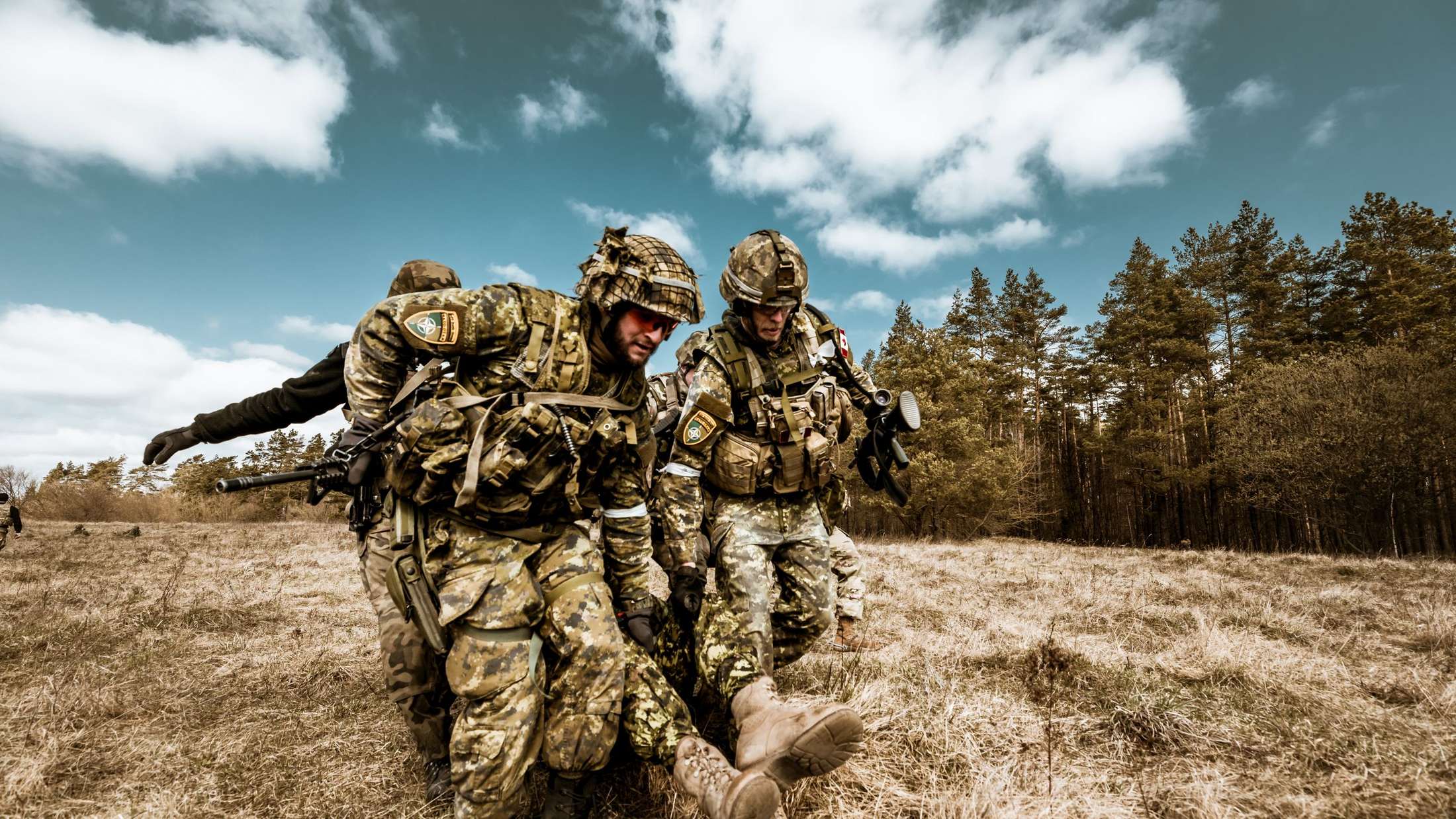
The hours after the injury now decide who survives.
Clinical-grade sensing woven into the uniform, turning what the body is doing into decisions a medic and a commander can act on when evacuation is delayed or denied.
NATO has retired the Golden Hour.
Evacuation can no longer be assumed. Airspace is contested, distances are longer, and what used to be a transfer measured in minutes is now care measured in hours, delivered by the people who are already there.
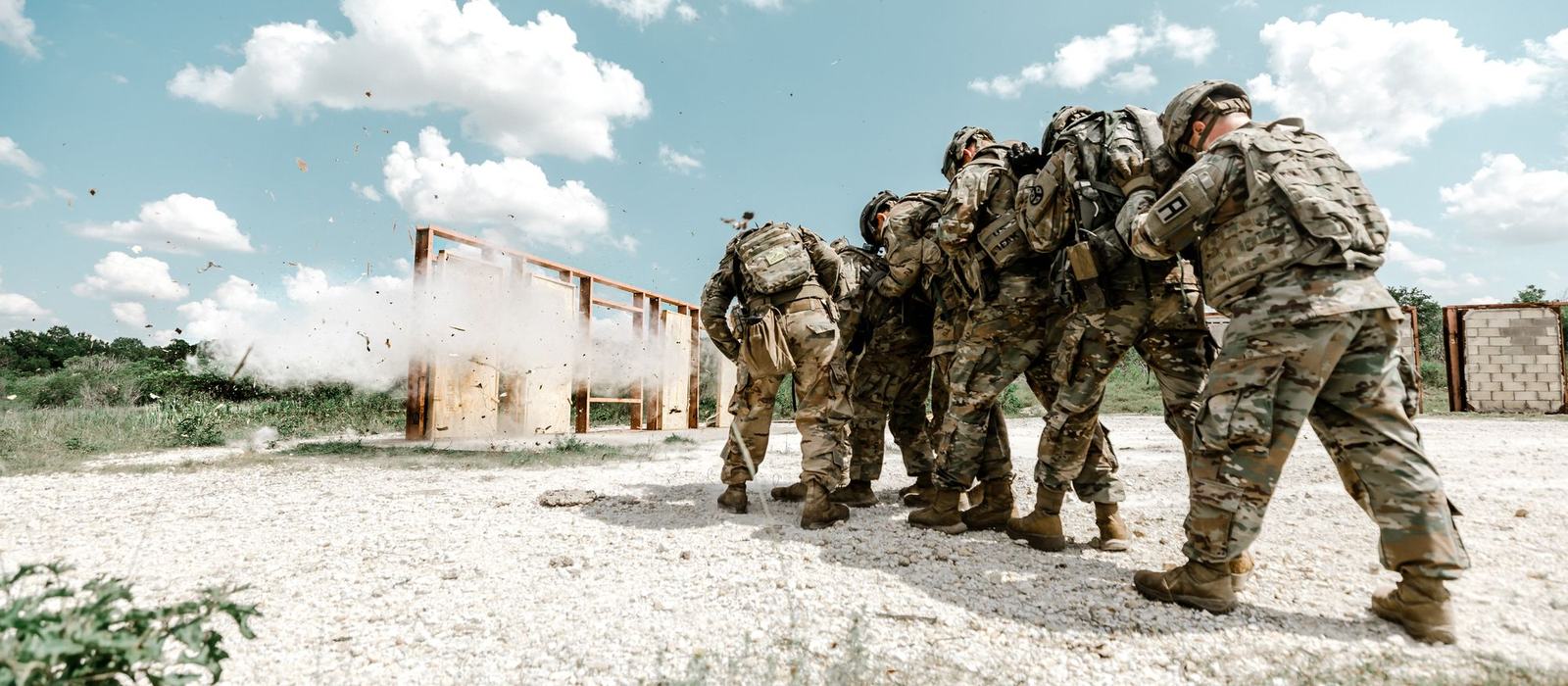
Evacuation is not a given
Prolonged field care is the planning assumption, not the exception.
The soldier is the least instrumented
Position, weapons and vehicles are tracked continuously. The human is checked by hand, at intervals.
Mass casualties break spot checks
One reading per casualty cannot say who is deteriorating fastest.
The record is written from memory
Documentation is reconstructed later, at the handover where continuity matters most.
What the field is asking for, and what it will not accept.
These are not our preferences. They are the constraints the operating environment sets, and the reason the product looks the way it does rather than like another wearable.
Sensing has to live in the uniform
Anything a soldier carries, charges or has to remember gets left behind.
Interpretation has to be personal
A reading is not a state. Value appears when signals are read against that soldier's own baseline, over time.
The decision stays with trained people
Hardware measures, software derives, the medic and the commander act. No autonomous diagnosis.
Nothing may be estimated
The engine never infers a measurement the hardware did not take, which keeps accuracy and intelligence separate claims.
Walletmed Heart is built to that requirement, not around a sensor we happened to have.
Sorting the wounded is only half the job.
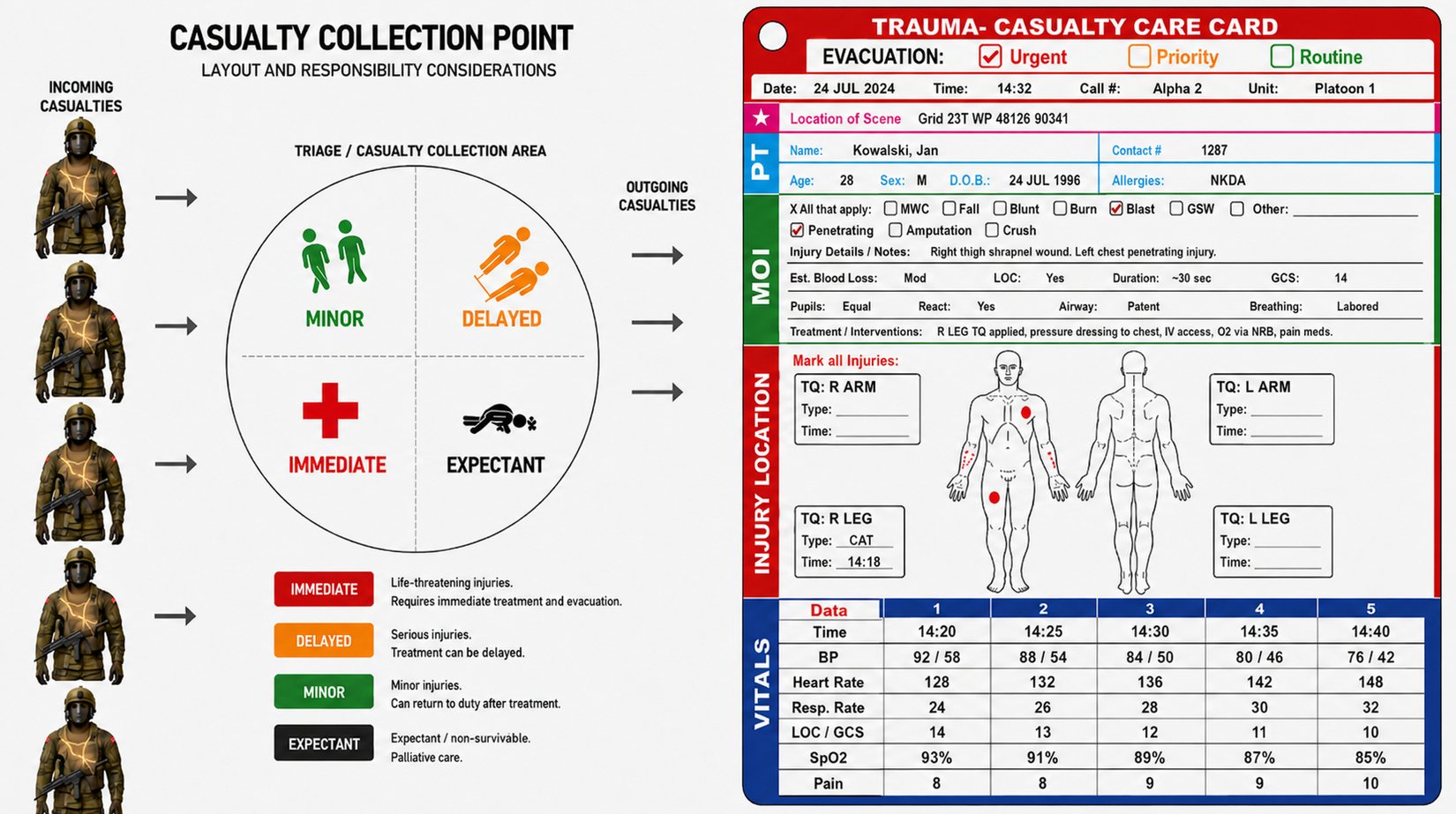
A casualty collection point separates immediate, delayed, minor and expectant. Every one of those decisions has to be justified by something measured, and every one has to be written down while the medic is still treating.
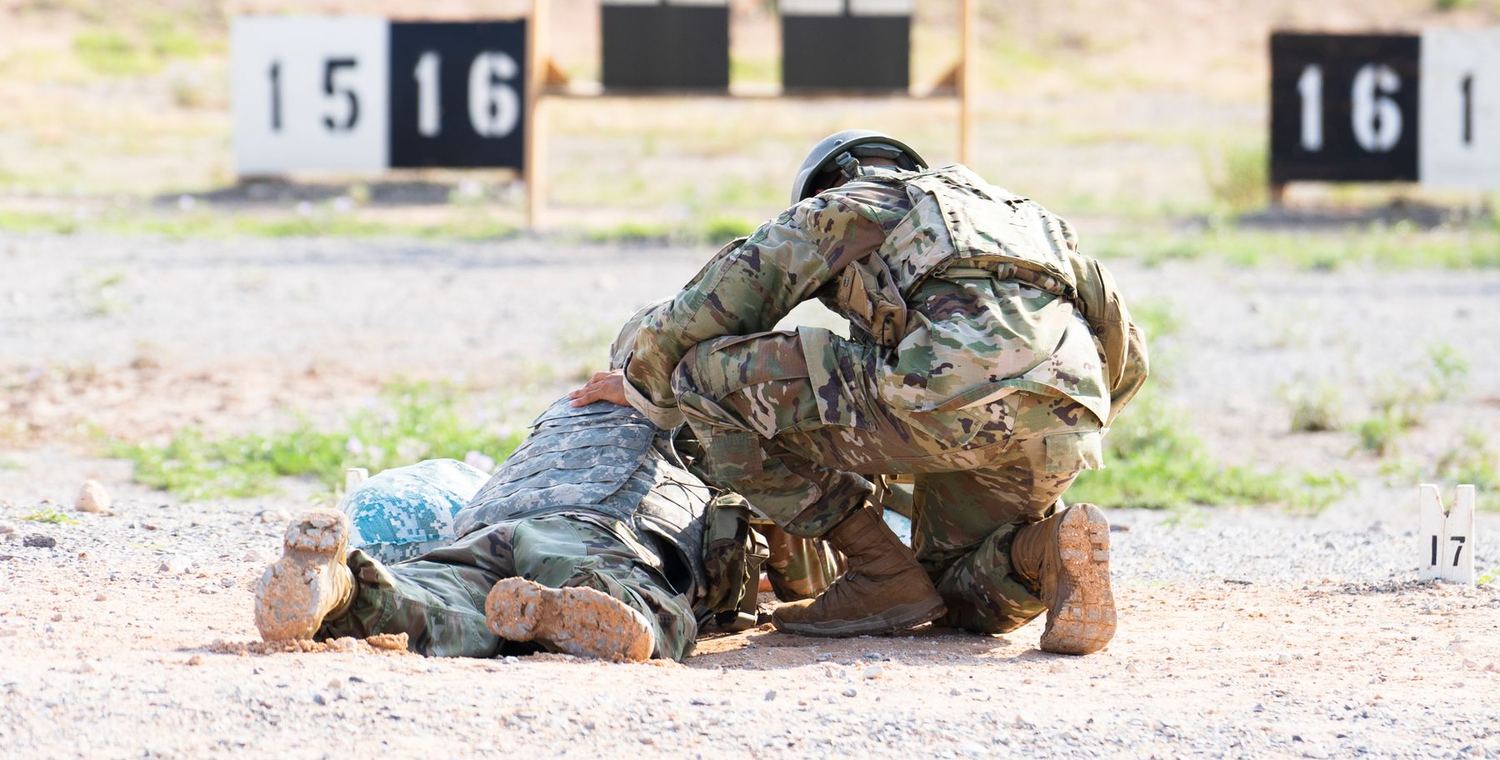
Sorting, supported
Priority comes from trend and deviation from that soldier's own baseline, not from one number taken under pressure.
Oriented before contact
The arriving medic already knows who is stable, who is deteriorating and who is the evacuation priority.
Continuous, not sampled
The wounded and the unwounded are tracked together, so deterioration is visible before it becomes an event.
Handover carries evidence
TACEVAC receives a continuous record with time stamps rather than a verbal summary reconstructed later.
The other half is the paperwork, written in the worst possible conditions.
Evacuation priority, mechanism of injury, interventions and a timed series of vital signs. The casualty care card is the document the whole chain of care depends on, and today it is filled in by hand, from memory, by someone whose hands are already busy.
What Walletmed Heart changes
The vital-signs block populates itself. Heart rate, respiratory rate, oxygen saturation, temperature and level of consciousness arrive already timed and already in sequence, so the medic confirms a record instead of composing one.
Why that matters downstream
A card carrying a real trend tells the receiving facility whether this casualty is holding or falling away. A single set of numbers written at handover never can.
Human state belongs in the picture the staff already works from.
Delivered into the systems and the radios the unit already uses, not as another network to run.
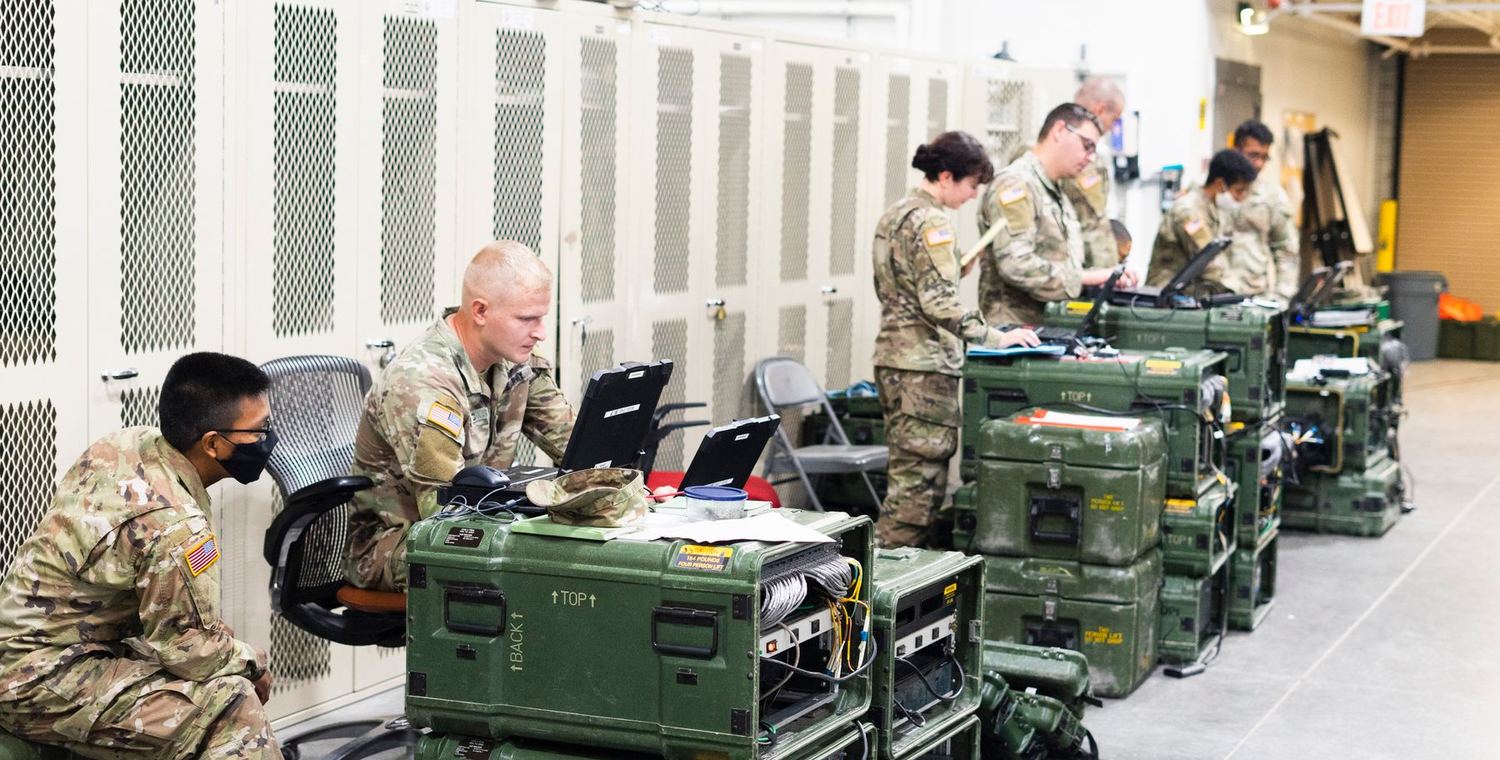
Readiness, not raw numbers
Who is degrading, who needs rotation, which element can still be tasked.
A record that follows the soldier
Trends and time stamps travel through point of injury, prolonged field care and evacuation.
Works without an uplink
Encrypted on device, buffered for 72 hours, carried over communications already in service.
No new burden
Nothing extra for the soldier to wear, charge or lose.
One continuous layer across the continuum of care.
Point of injury triage
Deterioration and shock indicators, and a casualty card drafted before the medic arrives.
Prolonged field care
Physiological trajectory preserved across hours, not isolated checks.
Evacuation handover
Vital-sign history and digital documentation travelling with the casualty.
Force awareness and training
Situational awareness for tasking, and heat strain, fatigue and force-load in training.
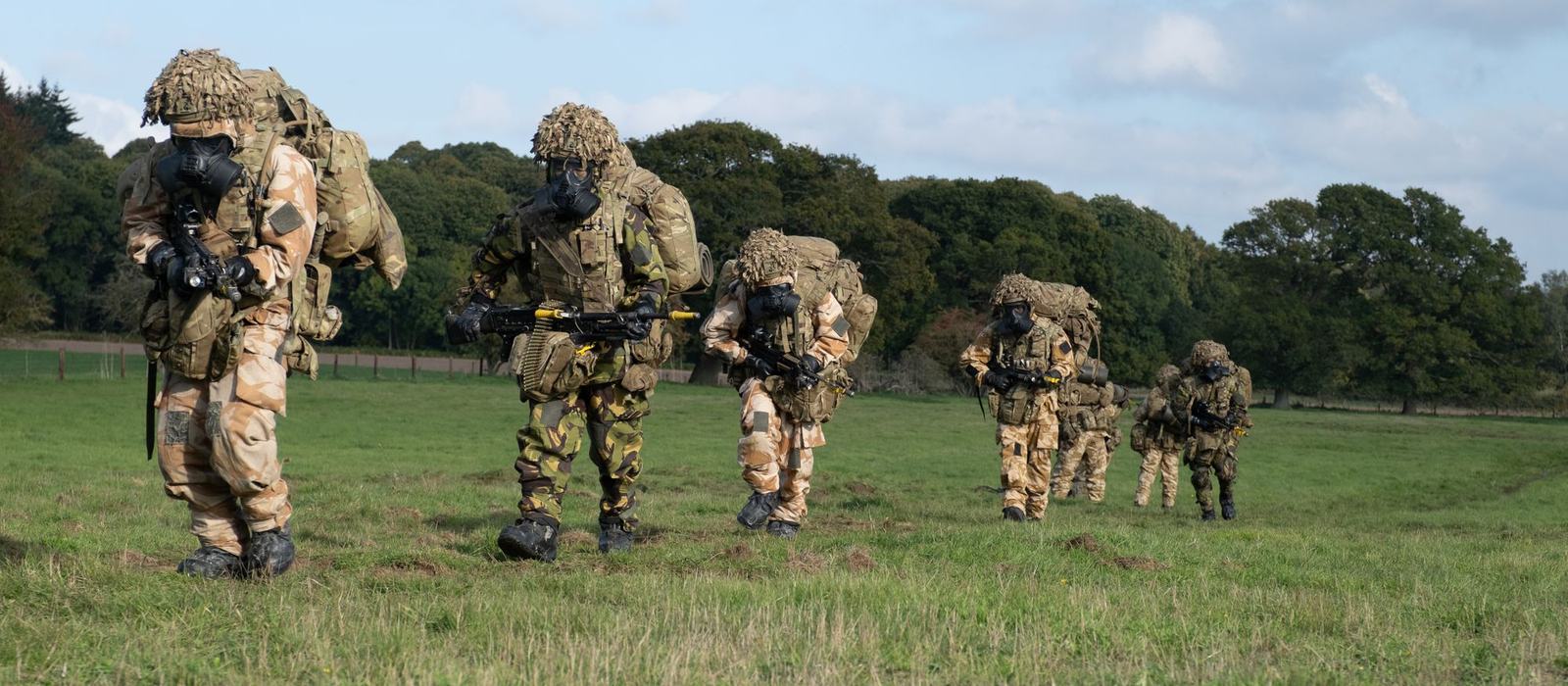
Adopters
- Armed forces and special operations
- Military medical services
- Civil protection, search and rescue, emergency medicine
Route to adoption
Partner-led. Walletmed Heart supplies established manufacturers of integrated soldier systems and protective combat clothing rather than selling direct to the force. The initial market is NATO high-readiness units, combat medics, training centres and special operations.
Two physical parts and one intelligence layer.
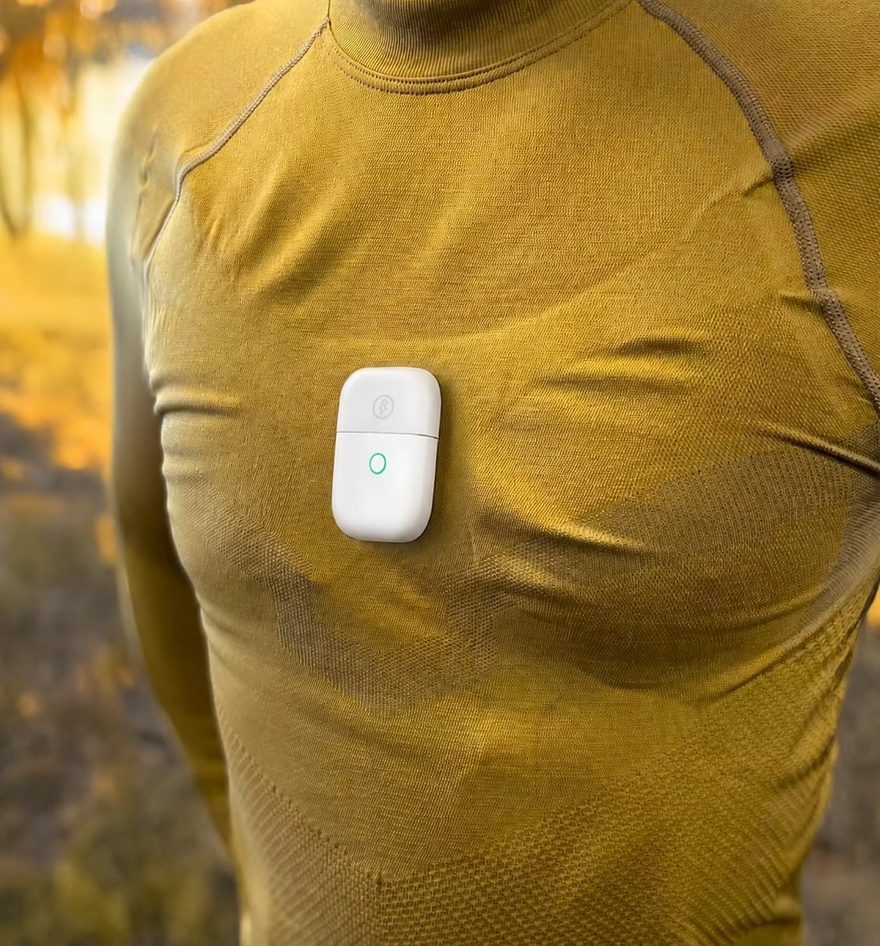
The garment
Textile electrodes woven around the torso carry the multi-lead ECG and bioimpedance interface. Washable, comfortable, woven in rather than snapped on.
The module
A detachable unit under 100 g carrying the non-ECG sensing, the analog front-end, encryption, the buffer and the radio link.
The intelligence
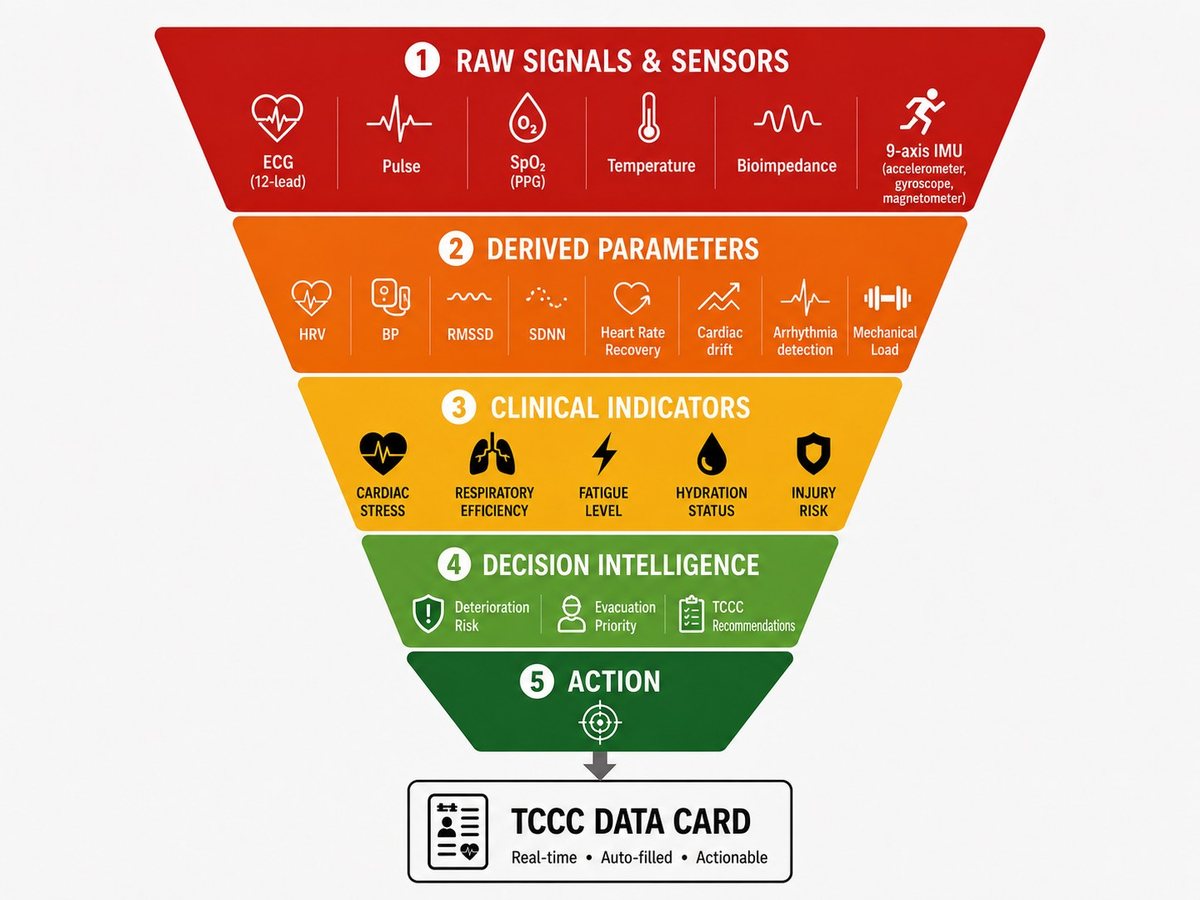
A four-level parameter hierarchy. Measured parameters first, then derived indicators built from how each soldier changes against their own baseline.
The output
Deterioration, shock, hypoxia, hypothermia and fatigue risk, an evacuation-priority index, and a drafted casualty card.
Every level adds meaning the level below cannot carry.
Raw signals become measured parameters, measured parameters become clinical indicators, and indicators become an evacuation priority and a completed card. The value grows as the levels rise, which is exactly what matters when evacuation is hours away.
A clearer casualty picture when the medic has too little time and too many decisions.
For programme, integration or evaluation enquiries.